

Lesson 6: Dengue
#🦟 Dengue Fever: A Comprehensive Guide for Medical Students & Practitioners
By: Parajuli SB, 2026
🌐 www.suryaparajuli.com.np
For: Community Medicine (Kathmandu University)
Level: MBBS 6th Semester
Institution: Birat Medical College Teaching Hospital
#🎯 Learning Objectives
By the end of this session, learners will be able to:
Understand the basics and epidemiology of dengue
Describe clinical features, diagnosis, and management
Explain prevention and control strategies
Discuss recent updates on dengue vaccines
Apply knowledge in clinical and community settings
#🧬 Introduction to Dengue
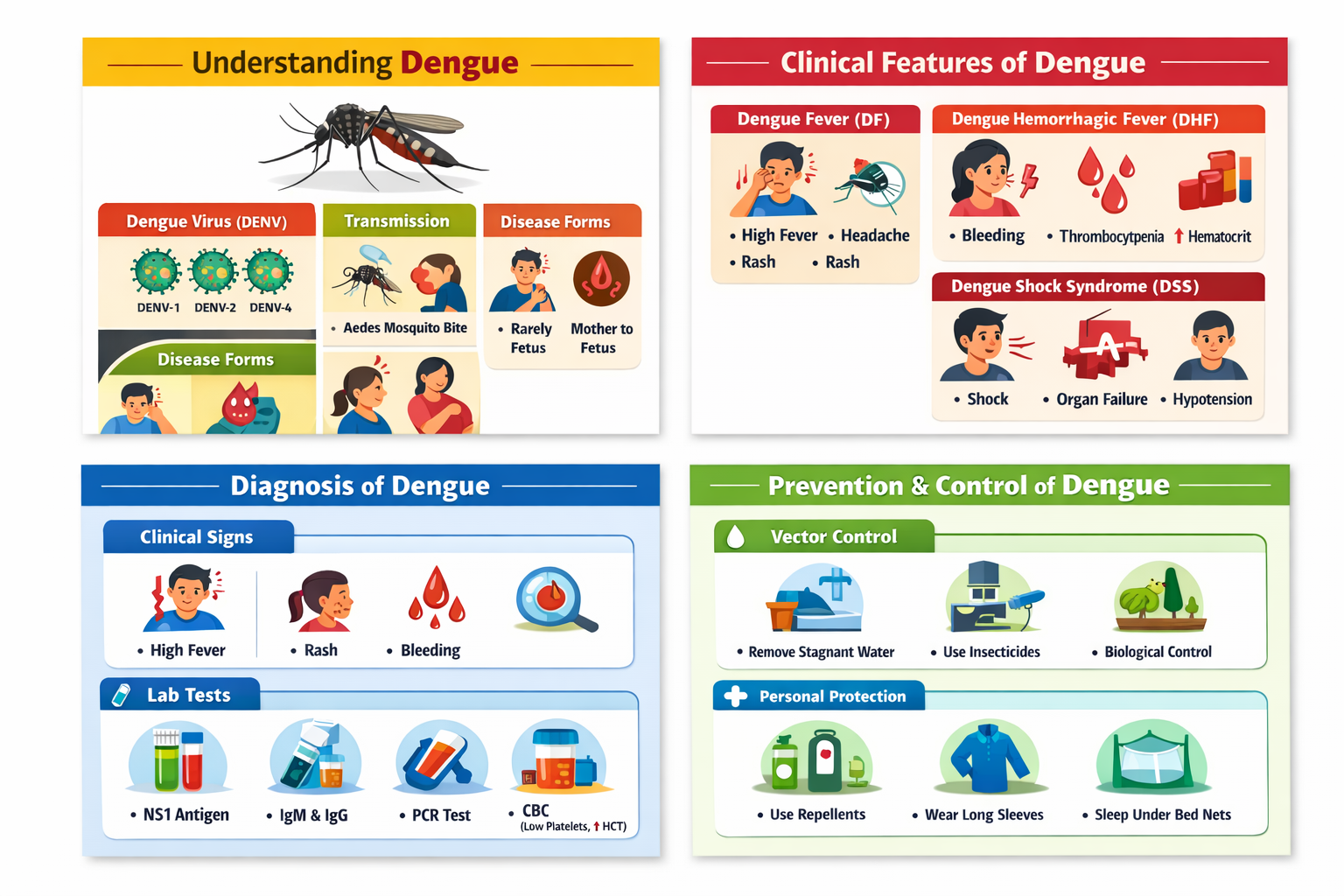
Dengue fever is an acute viral illness caused by the Dengue virus (DENV) and transmitted by infected mosquitoes:
Primary vectors: Aedes aegypti and Aedes albopictus
Disease spectrum:
Mild febrile illness
Dengue Fever (DF)
Dengue Hemorrhagic Fever (DHF)
Dengue Shock Syndrome (DSS)
#🦠 Causative Agent
Family: Flaviviridae
Four serotypes:
DENV-1
DENV-2
DENV-3
DENV-4
⚠️ What about DENV-5?
A fifth serotype (DENV-5) was reported in 2013 from Malaysia (Sarawak region)
It was identified in a sylvatic (forest) cycle, not typical human transmission
⚠️ Key Point:
Infection with one serotype → lifelong immunity to that type
Only temporary protection against others → risk of severe dengue
#🌍 Epidemiology
Endemic in more than 100 countries
Estimated 390 million infections/year
High burden in:
Southeast Asia
Caribbean
Central & South America
#📊 Trends
Increasing incidence due to:
Urbanization
Climate change
Poor sanitation
#🌧️ Seasonality
Peaks during monsoon season
#🔄 Mode of Transmission
🦟 Vector-borne: Bite of infected Aedes mosquito
👶 Vertical transmission: Rare (mother to fetus)
#⚙️ Pathogenesis
Virus enters through mosquito bite
Replicates in host tissues
#🔬 Important Mechanism:
Antibody-Dependent Enhancement (ADE)
→ Leads to severe dengue
#Severe Disease Features:
Increased vascular permeability
Plasma leakage
Shock
#🩺 Clinical Features
#1. Dengue Fever (DF)
High-grade fever
Retro-orbital pain
Rash
Leukopenia
#2. Dengue Hemorrhagic Fever (DHF)
Bleeding manifestations
Thrombocytopenia
Increased hematocrit
#3. Dengue Shock Syndrome (DSS)
Hypovolemic shock
Organ failure
Medical emergency ⚠️
#🔍 Diagnosis
#Clinical Suspicion
Fever + mosquito exposure
Rash, bleeding signs
#Laboratory Tests
NS1 Antigen: Early detection (Day 1–7)
IgM/IgG antibodies:
IgM → recent infection
IgG → past exposure
PCR: Gold standard
CBC findings:
Leukopenia
Thrombocytopenia
↑ Hematocrit
#💊 Treatment
🚫 No specific antiviral treatment
#Supportive Management:
Paracetamol for fever (avoid NSAIDs)
Adequate hydration (oral/IV)
Blood transfusion if required
#Hospitalization Indicated:
Severe dengue
Shock
Significant bleeding
#🛡️ Prevention and Control
#🦟 Vector Control
Eliminate stagnant water
Use insecticides
Biological control methods
#🧍 Personal Protection
Mosquito repellents
Long-sleeved clothing
Bed nets
#👥 Community Measures
Awareness campaigns
Environmental sanitation
#💉 Vaccines
Dengue vaccines exist but:
Limited availability
Restricted use in many LMICs
Ongoing research for safer and more effective vaccines
#🏛️ Public Health Strategies
#Integrated Vector Management (IVM)
Surveillance
Vector control
Community education
#National Programs
Dengue control initiatives
Outbreak response systems
#🔑 Key Takeaways
Dengue is a rapidly increasing global health problem
Severe disease linked to secondary infection (ADE)
No specific treatment → early detection is crucial
Prevention relies heavily on:
Vector control
Community participation
Climate change & urbanization are driving spread
#📌 Final Note
Dengue is not just a clinical disease—it is a public health challenge. Effective control requires integration of clinical vigilance, vector management, and community awareness.